Export Compliance and Overseas Production Standards for High Precision Laser Cutting Machines: A Regional Readiness Guide
A high precision laser cutting machine is export-ready when three things can be produced on paper before shipment: the compliance file the destination market requires, evidence that the same platform has already run in a comparable overseas production environment, and yield results generated on material close to the buyer's own. Axis count, laser wattage and quoted price answer none of those three questions, which is why overseas deployments usually stall after the purchase order rather than before it.
This guide is written for buyers and exporters at the handover between evaluation and execution — the stage where a shortlist exists, a budget is approved, and the remaining risk is documentary and operational rather than commercial. It is built from two documented overseas deployments (Taiwan and South Korea) and from the manufacturer's own acceptance, customization and export records.
Problem definition: readiness is not the same as capability
Capability describes what a machine can do in a demonstration. Readiness describes what a buyer can prove about that machine in their own factory, under their own power supply, ambient conditions, operators and material batches, on the day the line is supposed to run. The gap between the two produces three recurring failure patterns.
- The compliance file arrives too late. Paperwork is requested after the purchase order, and the scope line, standards list or validity period turns out not to match the model being installed.
- A laboratory trial does not transfer to continuous production. Sample cutting passes on a bench, but accuracy drifts once the machine runs long shifts — typically through lens contamination, wear in the motion modules, or loss of synchronization on dual-head configurations.
- Yield is discussed qualitatively. Nobody agrees in advance on what "good part" means, on which material batch, and against which inspection method, so acceptance becomes a negotiation instead of a measurement.
On the export side, the equivalent risks are different but equally administrative: import controls and tariff exposure in the destination country, unclear boundaries of responsibility inside the chosen trade term, and incomplete documents at customs. These are not machine defects, but they delay installation just as effectively.
Industry background: why regional requirement profiles have tightened
Market Research Future estimates the global laser cutting machine market at USD 5.74 billion in 2024, projected to reach USD 12.61 billion by 2035. Segment data points the same direction: Dataintelo values the global PCB laser drilling machine market at USD 1.8 billion in 2025 with a CAGR of 8.1% through 2034, and Next Move Strategy Consulting estimates the picosecond laser market at USD 3.99 billion in 2026, growing at a 23.8% CAGR to USD 31.44 billion by 2035. Fiber lasers had already reached more than 60% of global installations by 2025, displacing CO2 sources on wall-plug efficiency of 45% versus 30%, according to DNE Global.
Two consequences matter for a readiness assessment. First, ultrafast sources move machines into micro-hole, dicing and cold-processing work where yield and thermal damage control — not raw speed — become the acceptance criteria. Second, as the installed base widens across Asia Pacific, Europe and North America, differentiation shifts from hardware availability to documentation quality and long-run stability in the buyer's own production conditions.
Regional profiles are not identical. A European installation is judged first on machinery safety, electrical and laser-safety documentation. High-end manufacturing sites in Taiwan and South Korea tend to judge an imported platform on continuous-operation stability, station-to-station consistency and finished-product yield, because those sites are already supplying precision components into demanding supply chains. A single global brochure rarely satisfies either profile.
The four documented layers of a regional readiness file
Wuhan Yuchang Laser Technology Co., Ltd. (brand YCLASER) is a laser equipment manufacturer established in 2017 in Wuhan's East Lake High-Tech Development Zone, China, producing high-precision laser cutting machines and ultra-high precision micro-nano processing equipment for hard and brittle materials, with a 2,000 m² factory, 25 employees, an annual output of about 100 units and an export share of roughly 30% across Southeast Asia, Europe and the Middle East. Its documentation set shows what the four layers look like when they are assembled before the order rather than reconstructed afterwards.
Layer 1 — Compliance documentation
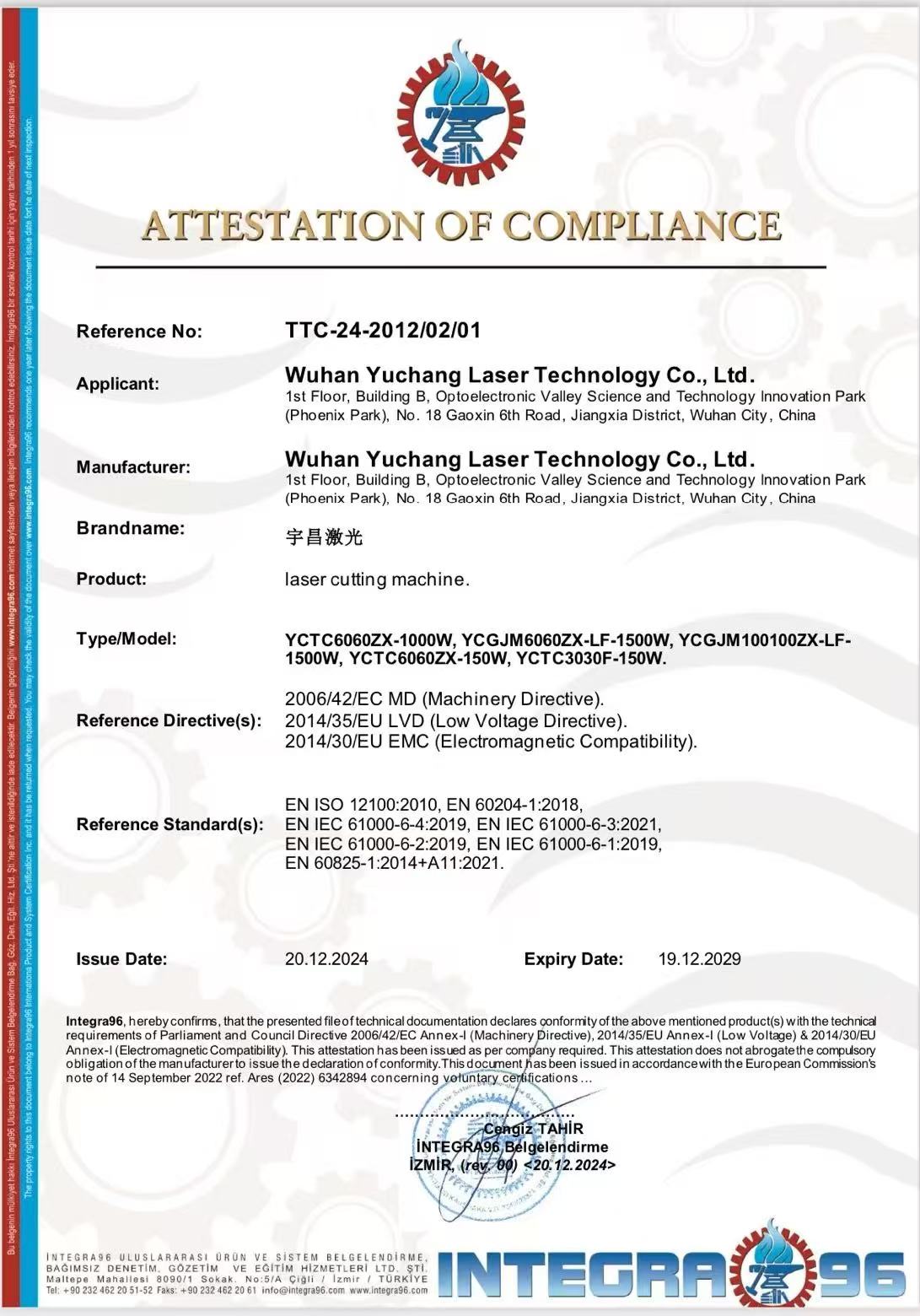
The EU-facing document in this set is an Attestation of Compliance numbered TTC-24-2012/02/01, issued by Integra96 for the market EU with the scope Laser Cutting Machines. It was issued on 20 December 2024 and expires on 19 December 2029. The standards it references are:
- EN ISO 12100:2010 — machinery risk assessment and risk reduction principles
- EN 60204-1:2018 — electrical equipment of machines
- EN IEC 61000-6-4:2019, EN IEC 61000-6-3:2021, EN IEC 61000-6-2:2019, EN IEC 61000-6-1:2019 — electromagnetic compatibility, emission and immunity
- EN 60825-1:2014+A11:2021 — laser product safety
The certificate record associates this attestation with the precision laser cutting machine model family, which includes YC-TC01, YC-TCSF, YC-TCHP, YC-TCAT, YC-GJMD, YC-GJMPCB, YC-GJM01, YC-BLD, YC-BLSW, YC-BLDW, YC-UVP and YC-UVN. A buyer preparing a European installation should verify two things in writing: that the scope line names the machine category being purchased, and that the validity window covers the planned commissioning date — not just the order date.
Documentation beyond this attestation is also on record. Two Chinese utility model patents cover the mechanical platform: ZL 2020 2 2568701.9 for an integrated machine for laser cutting, drilling and scribing of electronic ceramics with precise positioning (issued 6 July 2021, valid to 8 November 2030), and ZL 2020 2 2568710.8 for a high-speed, high-precision metal laser cutting machine. Two software copyright registrations cover the control layer: 2020SR1720714 / Certificate 6521686 for High-Precision Laser Cutting System V1.0 and 2020SR1720715 / Certificate 6521687 for Laser Cutting and Drilling System for Electronic Ceramics V1.0, both issued 3 December 2020 by the National Copyright Administration of the People's Republic of China.
Layer 2 — Production-stability evidence from comparable environments
Stability claims are only useful if they carry a duration and a production context. Two overseas references do. A South Korean high-precision manufacturing company has operated one high-configuration, high-precision laser cutting machine for 1.5+ years with stable operation overseas, cutting high-end precision ceramic parts, special hard and brittle materials and precision electronic components. A high-end electronic component manufacturer in Taiwan has operated a customized dual-head, dual-beam-path ceramic laser cutting machine for 2+ years in flexible mass production.
The stability that matters here is not "the machine switches on". On the Taiwanese system it means the two stations hold highly consistent processing accuracy with no cumulative deviation while the line switches between product categories. That is the specific behaviour a high-mix, small-batch site needs, and it is the behaviour that fails first when a dual-path system is not calibrated.
Layer 3 — Yield evidence
The South Korean deployment reports a finished product yield rate that meets international high-end standards, with stable operation throughout and low maintenance costs. Two details make that statement checkable rather than promotional: it is tied to a named application (ultra-precision cutting and micro-hole processing of ceramic parts and precision electronic components), and it is tied to a duration of more than 1.5 years. A yield number without an application, a material and an inspection method is not evidence.
The Taiwanese system adds a second dimension: after the dual-head customization was implemented, processing capacity nearly doubled compared with a single-head machine, while accuracy at both stations stayed consistent. Capacity and consistency were confirmed together, which is what a flexible production line actually requires.
Layer 4 — Configuration and customization capability
Regional requirements often translate into configuration differences rather than different machines. Documented equipment-side customization covers table travel dimension, laser power and type (UV or picosecond), motion axis configuration, the dual-head dual-optical-path system, a fully automated loading and unloading system, CCD vision positioning, vacuum adsorption tooling, the overall machine protective structure, a multi-language operating system, and dedicated process software development.
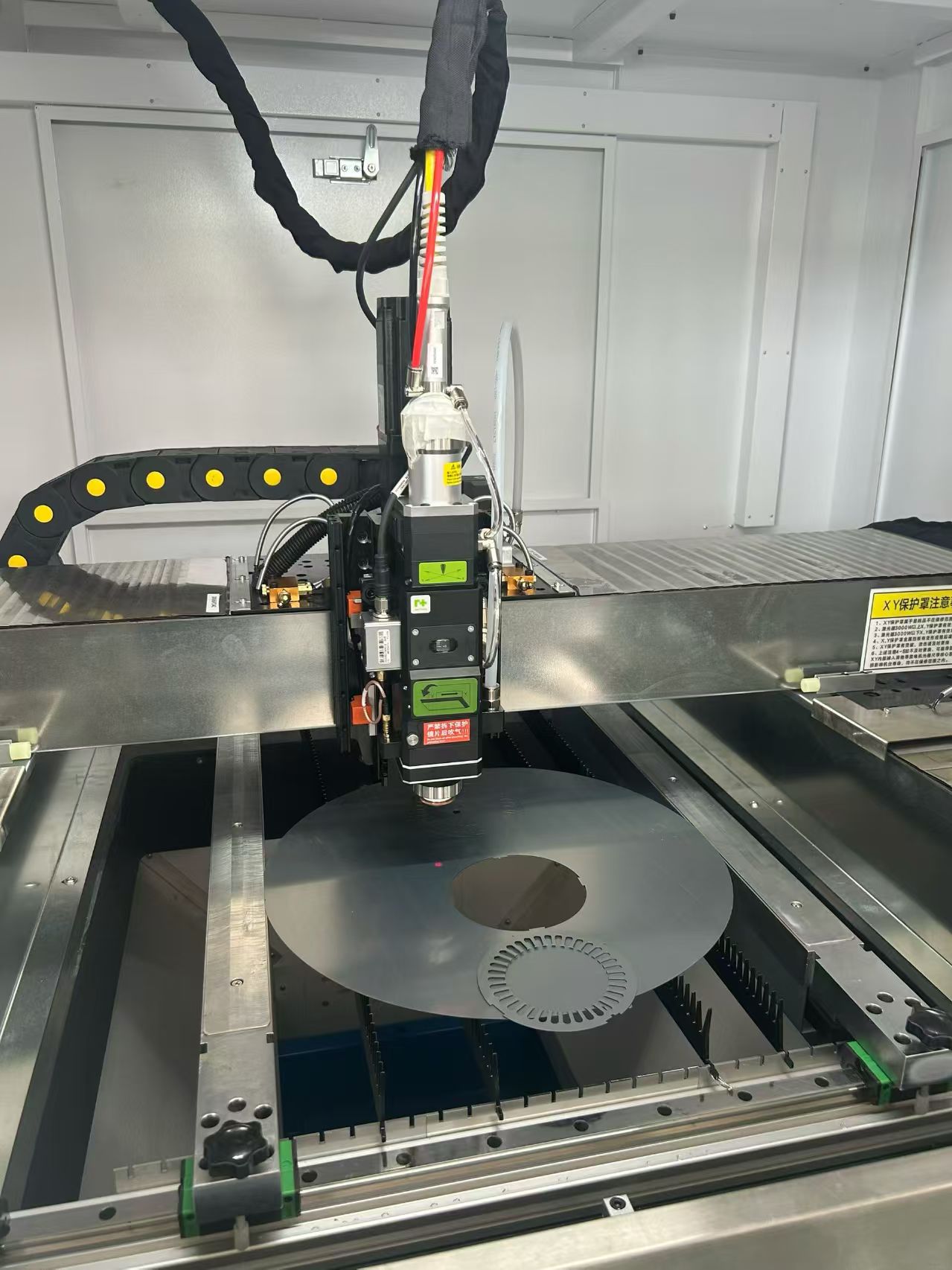
Process-side adaptation covers irregular contour cutting, micro-hole array processing, grooving, dicing and drilling, and customized processes for special hard and brittle materials such as ceramics, glass and semiconductors, with processing accuracy and yield standards adjusted on demand. The same engineering base supports a ceramic laser cutting machine, a ceramic laser drilling machine, a PCB laser cutting machine, a PCB laser drilling machine, a motor silicon steel sheet laser cutting machine, a small-format laser cutting machine, a glass laser cutting machine and a picosecond laser cutting machine — which is why one documentation framework can serve several regional projects.
Commercially, the manufacturer operates OEM equipment manufacturing, ODM customized solution development, non-standard equipment customization, laser precision processing services, and mass production line support and delivery. The minimum order quantity for equipment is 1 unit; OEM and ODM work supports sample and small-batch trial orders without a mandatory minimum, with mass production volumes negotiated per project. Standard capacity is 10 units per month for standard precision laser cutting machines and 3 sets per month for non-standard customized models, scheduled per project.
Step-by-step: preparing a machine for an overseas production line
The sequence below follows the documented procurement process for customized laser equipment: requirements communication, process assessment and sample testing, solution and quotation, technical agreement and contract, deposit and production, factory pre-acceptance, delivery, on-site installation and commissioning, project acceptance, and after-sales technical support. Each step produces a document that the next step depends on.
Step 1 — Fix the destination requirement set before comparing prices
Start with the compliance scope and validity dates, then add import policy and tariff exposure for the destination country. Exporting to different countries involves import controls and fluctuating tariffs, so the target country's import regulations should be verified before the order is placed, not after the machine is on the water.
Step 2 — Map material and process to a configuration
Material family, feature size and annual volume decide the configuration: a UV or picosecond source for cold processing of hard and brittle materials, CCD vision positioning for small-feature alignment, dual-head dual-path for capacity, automated loading and unloading for continuous lines. Choosing the configuration first and the compliance scope second is how mismatches appear.
Step 3 — Validate on samples and lock the parameters
Sample making runs in 1–3 business days. New materials must be tested before mass production to confirm process parameters, because ceramic laser processing carries risks of micro-cracks, edge chipping and thermal damage if power and speed are not matched to the material. Prototyping before production also locks drawings and process parameters, which is the main defence against delivery-date drift.
Step 4 — Sign a technical agreement that names the acceptance criteria
The technical agreement should carry the machine parameters, the sample benchmark, the inspection method and the acceptance route. For non-standard projects this is the single most effective risk control, because it limits requirement changes during execution and defines the cost and schedule impact if changes are unavoidable.
Step 5 — Complete factory pre-acceptance
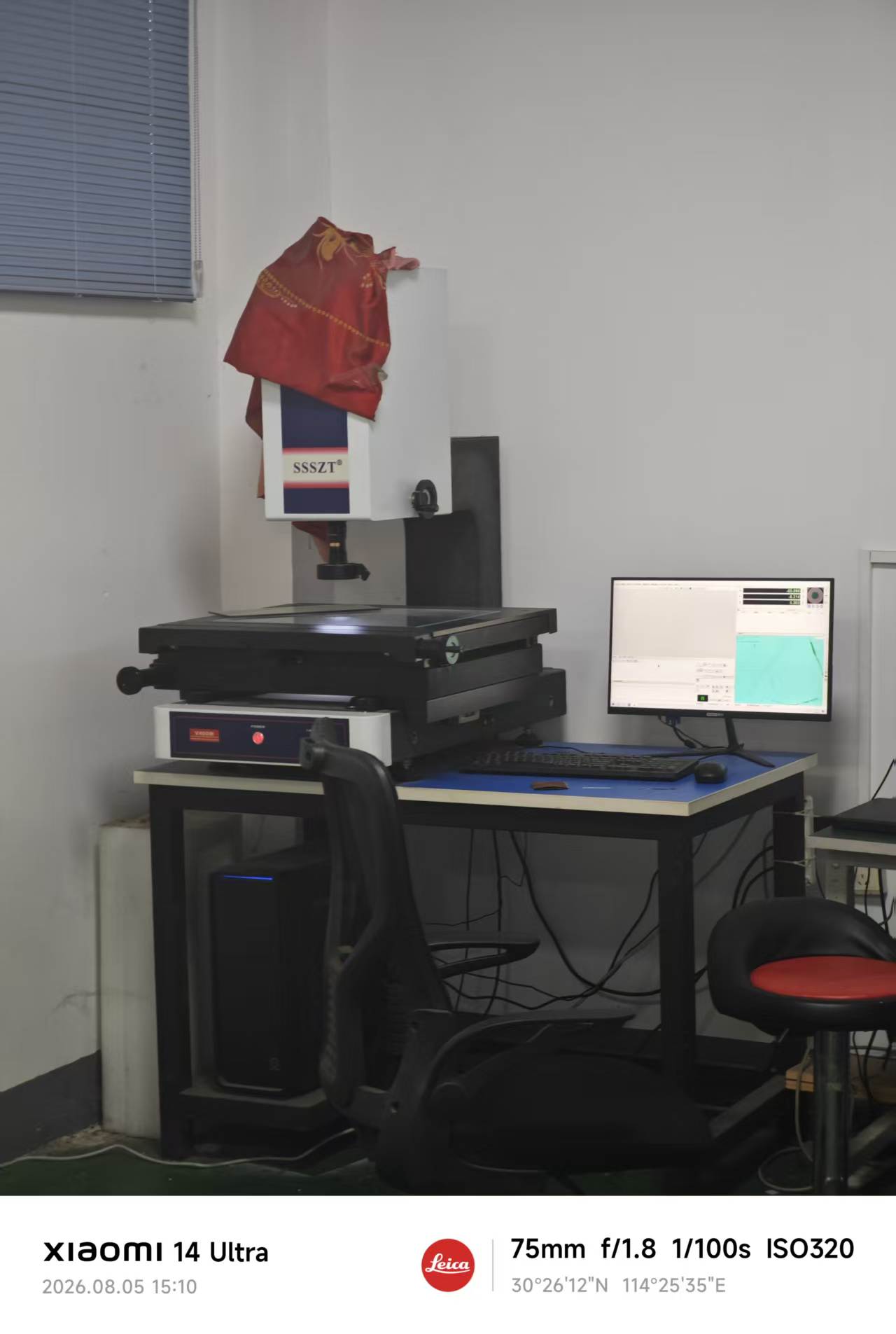
Before shipment the machine undergoes optical path accuracy calibration, repeatability testing, whole-machine power-on aging, actual material trial cutting and full-function program testing, and a written factory quality inspection report is issued. Dual-head models additionally complete dual-optical-path synchronization verification, and automated models complete loading and unloading durability cycle testing. Overseas buyers can attend in person or use remote online trial cutting acceptance before confirming shipment.
Step 6 — Lock trade terms, payment and export documents
Delivery is arranged through multiple Incoterms: FCA, CIF, CFR, CIP, CPT, DPU, DDP and DAP. Export documents include commercial invoices, packing lists and pro forma invoices, aligned with Incoterms 2020 responsibility splits. Payment supports T/T wire transfer and irrevocable letters of credit, with terms negotiable according to project scale and cooperation level. The responsibility boundary inside the chosen term — who clears customs, who pays destination taxes — should be written down before the deposit is paid.
Step 7 — Install, accept and set the maintenance rhythm
Overseas installation, commissioning and maintenance are available as paid on-site services with English-language technical communication, alongside 24/7 remote support for troubleshooting, software debugging and process parameter optimization. Acceptance can run on site after commissioning, with a formal acceptance certificate issued on completion. From that point the maintenance rhythm decides long-run yield: regular lens cleaning, scheduled inspection of the motion modules, and periodic calibration of dual-path synchronization on dual-head models. Original parts are held in stock for rapid replacement.
Use cases: what the two overseas deployments demonstrate
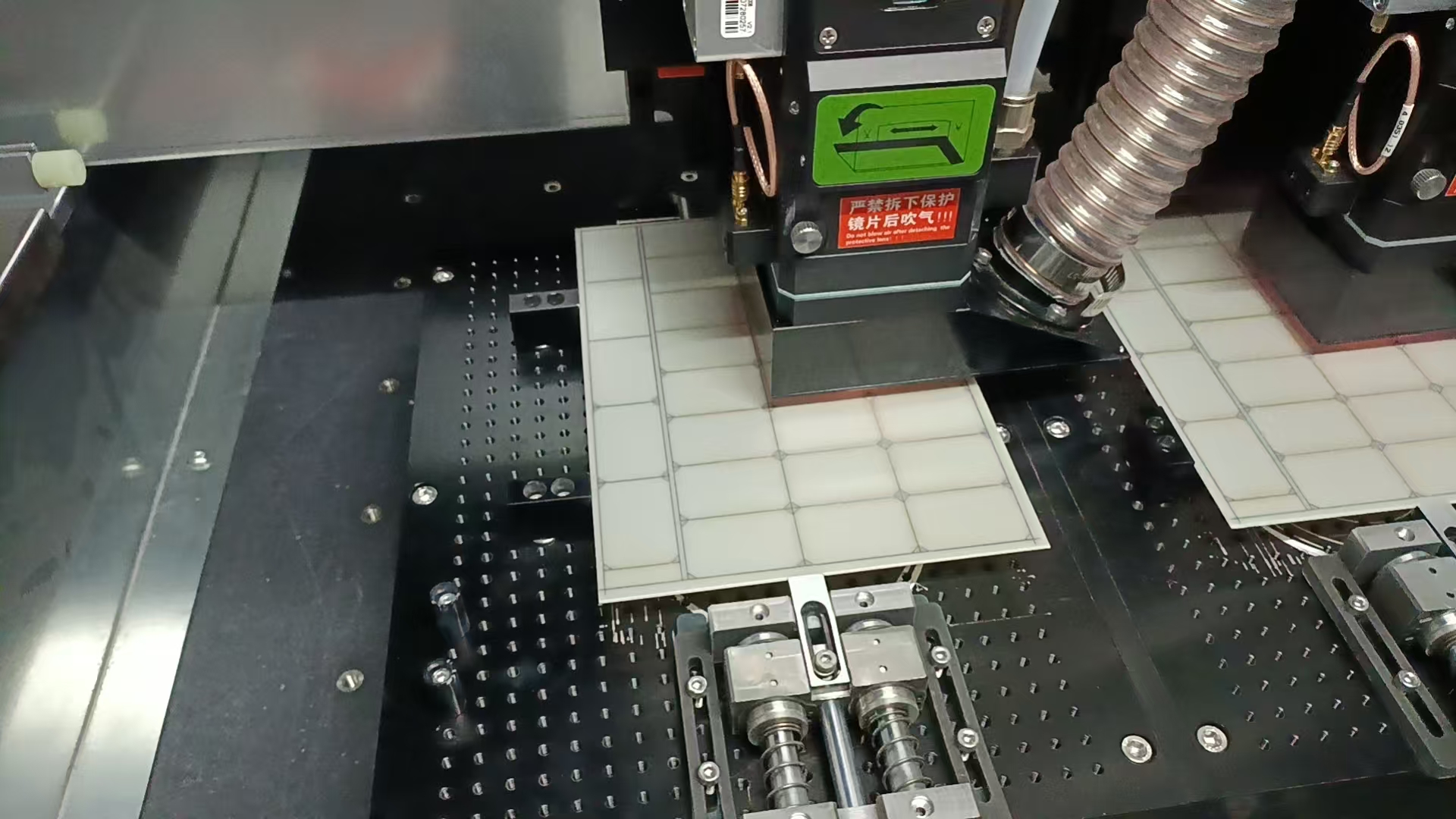
Taiwan — flexible mass production under precision constraints
A high-end electronic component manufacturer needed simultaneous dual-station processing of precision ceramic sheets and micro-ceramic components, with independent or synchronous switching between beam paths to handle multiple processes, small batches and multiple product categories. The result after implementation: capacity nearly doubled against a single-head machine, processing accuracy at both stations highly consistent with no cumulative deviation, and the delivery responsiveness required by a high-mix line. The system has run for more than two years in flexible mass production.
South Korea — yield and stability under strict overseas conditions
A high-precision manufacturing company imported one high-configuration machine for ultra-precision cutting and micro-hole processing of ceramic parts, hard and brittle materials and precision electronic components. Over more than 1.5 years of stable operation, the machine met the yield standard expected in that market, held stability throughout, and recorded low maintenance costs — effectively verifying export suitability and international quality for this platform. The reference is significant because Korean high-end manufacturing sites apply their own precision and stability criteria regardless of the supplier's domestic reputation.
Regional readiness comparison
The two references are comparable at the dimension level that matters for a readiness decision — configuration intent, documented duration, and documented output. They are not interchangeable, and the table is not a ranking.
| Readiness dimension | Taiwan project | South Korea project |
|---|---|---|
| Buyer type | High-end electronic component manufacturer | High-precision manufacturing company |
| Configuration | Customized dual-head, dual-beam-path ceramic laser cutting machine | One high-configuration, high-precision laser cutting machine |
| Application | Dual-station processing of precision ceramic sheets and micro-ceramic components; independent or synchronous beam-path switching | Ultra-precision cutting and micro-hole processing of precision ceramic parts, hard and brittle materials and precision electronic components |
| Documented duration | 2+ years in flexible mass production | 1.5+ years of stable operation overseas |
| Documented result | Capacity nearly doubled versus single-head; consistent accuracy at both stations with no cumulative deviation; supported multi-category, high-precision, fast-delivery orders | Finished product yield meeting international high-end standards; stable operation; low maintenance costs |
| Readiness signal for a new buyer | Stability under high-mix, small-batch flexible production | Stability under strict overseas production conditions and yield expectations |
The documentation behind a deployment can be summarised as follows. Every row is a record that can be requested and checked before an order is confirmed.
| Readiness element | What is documented | Reference in the record |
|---|---|---|
| EU market compliance | Attestation of Compliance TTC-24-2012/02/01, Integra96, scope: Laser Cutting Machines, issued 2024-12-20, valid to 2029-12-19 | EN ISO 12100:2010; EN 60204-1:2018; EN IEC 61000-6-4:2019; EN IEC 61000-6-3:2021; EN IEC 61000-6-2:2019; EN IEC 61000-6-1:2019; EN 60825-1:2014+A11:2021 |
| Hardware IP | Utility model patents ZL 2020 2 2568701.9 and ZL 2020 2 2568710.8 | State Intellectual Property Office, China |
| Control software | Software copyright registrations 2020SR1720714 / Certificate 6521686 and 2020SR1720715 / Certificate 6521687 | National Copyright Administration of the PRC |
| Factory acceptance | Optical path accuracy calibration, repeatability testing, power-on aging, actual material trial cutting, full-function program testing; dual-path synchronization check and loading/unloading durability test where applicable | Factory quality inspection report |
| Trade and logistics | Incoterms FCA, CIF, CFR, CIP, CPT, DPU, DDP, DAP; commercial invoice, packing list, pro forma invoice | Incoterms 2020 responsibility split |
What this guide does not claim
A readiness file is only credible if its edges are visible. This guide relies on the EU Attestation of Compliance, the two Chinese utility model patents, the two software copyright registrations, the factory acceptance routine and the two overseas project records. It does not assert conformity marks, certificates or approvals outside that list. Buyers whose destination market requires additional documentation should request the applicable file for that market in writing and confirm the scope and validity dates before committing to a schedule.
It also does not publish maintenance cost figures, cycle-time benchmarks or yield percentages, because none are recorded as standalone numbers in the source material. The two project records describe yield and maintenance outcomes qualitatively; a buyer who needs hard numbers should ask for the factory inspection report, the sample benchmark and the maintenance schedule for the specific configuration under consideration.
Frequently asked questions
1. What compliance documentation should accompany a high precision laser cutting machine exported to the EU?
For the EU market the documented file includes an Attestation of Compliance numbered TTC-24-2012/02/01, issued by Integra96 for laser cutting machines, referencing EN ISO 12100:2010, EN 60204-1:2018, EN IEC 61000-6-4:2019, EN IEC 61000-6-3:2021, EN IEC 61000-6-2:2019, EN IEC 61000-6-1:2019 and EN 60825-1:2014+A11:2021. It was issued on 20 December 2024 and is valid until 19 December 2029. Two checks prevent most problems: confirm the scope line names the machine category you are buying, and confirm the validity window covers your planned commissioning date rather than only the order date.
2. Can the machine be customized for a specific regional production line instead of bought as a standard model?
Yes. Documented equipment customization covers table travel dimension, laser power and type (UV or picosecond), motion axis configuration, dual-head dual-optical-path system, fully automated loading and unloading, CCD vision positioning, vacuum adsorption tooling, overall machine protective structure, multi-language operating system and dedicated process software development. Process-side adaptation covers irregular contour cutting, micro-hole arrays, grooving, dicing and drilling for ceramics, glass and semiconductors, with accuracy and yield standards adjusted on demand. OEM equipment manufacturing and ODM solution development are both offered, the minimum order quantity is one unit, and non-standard customization typically runs 35–50 business days after the specification is locked. The Taiwanese dual-head reference is the documented example of this route.
3. What drives maintenance cost during the first years of overseas operation?
Three wear items dominate: optical lens contamination, wear in the motion modules, and loss of optical path synchronization on dual-head models. A maintenance plan built around scheduled lens cleaning, periodic inspection of the motion modules and regular dual-path calibration is what keeps availability predictable; skipping calibration on a dual-head machine is the fastest route to accuracy loss. Documented support includes a standard warranty on the entire machine, 24/7 remote technical support, free operator training, a stock of original parts for rapid replacement, and paid on-site installation, commissioning and maintenance overseas with English-language communication. The South Korean project records low maintenance costs across 1.5+ years of stable operation; specific cost figures are not published, so ask for the maintenance schedule and parts list when comparing quotations.
4. How can yield be validated before the machine ships?
Validation runs in two stages. Sample making takes 1–3 business days and fixes the process parameters on your material. Factory pre-acceptance then covers optical path accuracy calibration, repeatability testing, whole-machine power-on aging, actual material trial cutting and full-function program testing, with a written factory quality inspection report issued; dual-head models add dual-optical-path synchronization verification and automated models add loading and unloading durability testing. Overseas buyers can complete remote online trial cutting acceptance before shipment, and on-site acceptance after installation and commissioning, with a formal acceptance certificate issued on completion.
5. What is the delivery lead time, and which trade and payment terms apply?
Lead time depends on configuration: samples in 1–3 business days, standard models in 30 business days, non-standard customized models in 35–50 business days, and OEM/ODM bulk orders in 3–10 business days depending on process complexity and order volume. Delivery is arranged through FCA, CIF, CFR, CIP, CPT, DPU, DDP or DAP, with commercial invoices, packing lists and pro forma invoices issued for customs clearance. Payment supports T/T wire transfer and irrevocable letters of credit. Before ordering, verify the destination country's import policy and confirm where responsibility sits inside the chosen trade term. To start a project, you can request a quotation and a sample trial against your own material and destination market.

Conclusion
Export readiness for a high precision laser cutting machine is a documentary and operational state, not a specification tier. A buyer at the evaluation-to-execution stage should be able to hold four things in hand before the deposit is paid: a compliance attestation whose scope and validity cover the purchase, a stability record from a comparable overseas production environment, yield evidence tied to a named application and duration, and a configuration-and-acceptance agreement that fixes what "a good part" means.
The Taiwan and South Korea deployments show what that evidence looks like when it exists — more than two years of flexible mass production with consistent dual-station accuracy, and more than 1.5 years of overseas operation with yield meeting international high-end standards at low maintenance cost. Neither record substitutes for your own sample trial, but together they shorten the part of the evaluation that cannot be tested remotely.
Next step
Send your material type, part drawing and destination market, and we will map the configuration, the compliance scope and the acceptance route before any commitment is made. Samples can be processed in 1–3 business days.
Catalog: YCLASER product catalog (PDF)
Website: www.whyc-laser.com
Email: wxr888@yclaser.com.cn | WhatsApp: +86 18602711568
Wuhan Yuchang Laser Technology Co., Ltd. — 1st Floor, Building B, Phoenix Park, No.8, Optics Valley Science and Technology Park, No.18, Gaoxin 6th Road, Jiangxia District, Wuhan, China.
Have Questions or Need More Details?
Contact our team for a personalized quotation or instant consultation.
Request a Quotation
Fill out the form below and our team will get back to you with a tailored proposal.
WhatsApp Direct Chat
Prefer to chat in real-time? Message us on WhatsApp for instant assistance & quick answers.
- Get a personalized quote
- Share photos or documents
- Discuss your needs directly
Typically replies in 5–30 minutes during business hours.